Friday, 20 June 2014

The Sweet Delights of Istanbul

Picture yourself standing in the streets of Old Istanbul.  Point your finger in any given direction and what do you see?

Chances are it will be a shop selling Turkish delight and baklava.

On a recent short jaunt to this fabulous city, I roamed the cobbled streets of the old town and, along with the fascinating history of Istanbul, absorbed the sweet aroma of Turkey’s ample confectionaries.
Haci Bekir sweet shop

Istanbul, apart from being one of the most visited cities on the planet, has a rich and deep history stretching back to the hallowed times of Constantinople (its former name) and the eastern Roman Empire, the clash between the Crescent and the Cross, and the heady days of the merchant-filled Silk Road.  It’s vast Ottoman Empire heralded sultans, both good and bad, embracing the vast diversity of the new and old worlds.  The breathtaking architecture, Iznik ceramics and Byzantine frescoes draw the visitor into a past world of imperial splendour and mercantile wealth.

Nowadays, the slow and steady pace of camels and caravanserais have been replaced by modern jet travel, ships steaming in all directions, efficient public transport, numerous hotels and a multitude of visitors with their ubiquitous iPads.  And the feel of Istanbul is still that of a bustling crossroads of cultures.  Sit on any public bench by the busy Bosphorus waterway and you will see the world’s people in all their hues, head-dresses and habits, pass peacefully in front of your eyes. 

Of course, with all this breathless sightseeing, there is always the need to boost the energy levels with some of the tastier local delights.  As I walked down a busy street in the traditional stock exchange area, I happened upon a delightful little shop with an enticing traditional window display of sweet treats.  I couldn’t resist going inside.
Haci Bekir's Turkish Delight

The bell above the door tinkled magically as I walked in to the quiet oasis of the Haci Bekir Confectioners.  Established in 1777 by Bekir Effendi, a sweetmaker from Anatolia, Haci Bekir is a Turkish confectionary institution.  Apparently, 250 years ago, sweets in Turkey were rather hard.  Bekir Effendi decided to change this and concocted a soft bite-sized confection made of gel of starch, sugar and natural fruit flavourings. Legend has it that the sweetmeat called lokum (the Arabic word for morsel) became very popular with the well to do.  A common trend was to wrap these deliciously soft little tidbits inside silk handkerchiefs and gift them to friends or loved ones.


Of course, it wasn’t long before lokum made its way to the Ottoman court and the Sultans gave it their royal approval.  Historical sources reveal that lokum was a favourite of the ladies in the palace harem, who would order boxes of the stuff to sweeten their mouths amidst all that palace intrigue.


The business is still run by the same Bekir family and the original shop in Bahçekapi District exists – with a few interior design changes – today. When you step inside you are greeted by reverentially quiet salesmen, welcoming you to their world of sweet serenity.

Now, for those of you who have ever visited Turkey, haggling and striking a bargain is expected almost everywhere.  But not in this quaint sweet shop. The calmness of the owners invites you to take your time, taste the wide array of their wares and choose at your leisure.

Faced with so much choice, and no pressure to buy, a visit to Haci Bekir is a must on anyone’s travel itinerary.

And now for the baklava!

Although baklava can be found in Iran, this melt-in-the-mouth pastry delight is indisputably Turkish in origin.  Scholars believe it to be based on the Turkic word and culinary tradition of layering breads.  The recipe reputedly originates from the kitchens of the Ottoman Topkapi Palace, majestically overseeing the city. 

Over the years, the making of baklava has modified to layering filo pasty in a large tray with layers of pistachios, walnuts or hazelnuts.  Before baking, the pastry is cut into diamond shapes and baked.  Once cooked, it is drizzled with oodles and oodles of honey syrup.
Baklava at the Hafiz Mustafa Bakery

And if you are in Istanbul, a must stop on the way back from the Topkapi Palace (and conveniently opposite Haci Bekir) is to pop into the Hafiz Mustafa Bakery.  It’s sidewalk tables are always packed with locals and tourists alike consuming cakes and sweets and drinking tea.

After a day of taking in Ottoman art and culture, I went into this lively cafĂ© for a refreshing cuppa.  Positioning myself deliberately in front of the trays of baklava, my tea was brought to me by a pirouetting waiter, deftly depositing tea and cakes at tables without a drop spilt or a crumb lost.

I leave you to ponder the delights of the Middle East with Tess Mallos’ recipe for baklava from her book The Complete Middle Eastern Cookbook.  I would have to confess however, that although I have often been tempted to make baklava, I have never had the courage to do so.

I do think that if you really want to taste Turkish baklava, you need to get on a jet camel and head to Istanbul.


Baklava

What you need:

185 grams unsalted butter, melted
20 sheets of filo pastry
250 grams finely chopped walnuts or pistachios
155g grams finely chopped almonds
55 grams caster sugar
2 teaspoons ground cinnamon
⅛ teaspoon ground cloves

For the syrup:
330 grams of sugar
90 grams honey
Thinly peeled strip of lemon rind
1 small piece of cinnamon bark
3 cloves
2 teaspoons lemon juice

1 baking dish approximately 23 x 33 x 5cm (9 x 13 x 2 inch)

What to do:
Preheat the oven to 160°C (320°F, Gas 2-3).
Brush the base and sides of the dish with melted butter.
Place nine sheets of filo pastry, one at a time, into the dish, brushing each layer with melted butter as you place it in the tray.
In a separate bowl, mix together the nuts, sugar and spices. Spread half of this nut mixture over the pastry.
Cover the nuts with another two sheets of filo pastry, brushing each layer with butter.
Spread the remaining nuts on top and finish with the remaining filo pastry, brushing each layer with melted butter.

Trim the pastry edges and brush the top with butter.
Take a sharp knife and (cutting the baklava right down to the base) cut the baklava into a diamond pattern.
Sprinkle the top lightly with water to prevent the top layers from curling upwards.
Bake in the middle of the oven for 30 minutes. Move the baklava to a higher shelf in the oven and bake for another 30 minutes. If you see the top starting to brown or colour, then place some baking parchment or tin foil on top of it.
Allow the pastry to cook thoroughly.

While the baklava is cooking, make the syrup.  Put the sugar and honey in a heavy-based saucepan with 375 ml of water.  Keep the heat at a moderate temperature and stir continuously until the sugar is dissolved.  Then add the remaining ingredients, bring to the boil and let boil for 15 minutes.  Strain and cool.

When the baklava is cooked, spoon the cooled syrup evenly over it.  Leave the baklava for several hours before serving.


Tuesday, 10 June 2014

The Gilaneh’s Torsh-e Kebab

The way to a man’s heart…

… is to listen to him.

And when that fails, take him out for some torsh-e kebab!

Which is what I had to resort to this week, when we paid a visit to the Gilaneh Restaurant, home of northern Iranian food in Tehran on Jordan Street.  We went there specifically to try out that particularly Caspian kebab.

The reason for this treat was my food faux pas of not listening to the man I have been married to for 28 years.  Not that this is a cardinal sin in of itself, but I failed to pick up the obvious – he likes torsh-e kebab, a sweet and sour delight made with a mix of pomegranate syrup and walnut paste.

Gary finally finds his torsh-e kebab

A few weeks ago, we were travelling in Mazandaran Province, right next to the Caspian Sea, and stayed in the old seaport of Babolsar.  Over lunch one day with some friends, Gary was absorbed in consuming copious quantities of this torsh-e kebab – even though he did not know that was what it was called. I was deeply involved in conversation with others, ignoring both the dish in question and my better half.

On the long drive back, Gary huffily moaned – repeatedly – that he had found something new he loved to eat and I didn’t even notice, let alone take a photo, never mind asking about what it was called. 

And so, since then I have been on a culinary guilt trip of monumental proportions.  This has led me to describing to various people what it was that Gary ate and then triangulating the evidence to eventually conclude that the enigmatic meal was in fact torsh-e kebab.

Having concluded that torsh-e kebab was probably the mystery item, the final leg in my odyssey led us to the Gilaneh Restaurant, a corner of the Caspian tucked away just a few metres off Africa Boulevard in the northern part of Tehran.  The restaurant oozes a combination of traditional charm and modern crispness.  Seated at old-style wooden tables, surrounded by household items of days gone by, we relaxed for a delicious, unhurried meal.  We could just feel as if we were sitting in some tavern by the Caspian, mist rolling in off the sea.  Modern fusion music brought us into the current century, and helpful smiling waiters brought us menus. 

Gilaneh Restaurant in Tehran
Knowledge is power and it didn’t take long to find the torshe-e kebab on the menu.  A choice of meat, lamb or chicken was offered to us, and of course torshe-e kebab juje was ordered.  The blend of pomegranate and walnut lends to purplish-red looking meat with the tangiest of tastes.  Although normally served with kateh, a Mazanderan easy-to-cook rice dish with oil and salt, we chose our favourite saffron topped rice.  Add to that a fabulously zingy salad, and I can’t remember the last time we ate kebabs so quickly. 

It tasted that good!

So, the moral of the story is, if you still don’t listen to the one you love, you can always Google a good restaurant to get you off the hook!


Torsh-e Kebab

What you need:

1 kg chicken, lamb or beef
1 cup walnuts
¾ cup of pomegranate syrup
2 to 3 tablespoons olive oil
2 to 3 cloves of garlic, crushed
1 cup of fresh parsley, finely chopped
Salt and freshly ground black pepper to taste
Metal or bamboo skewers for grilling

What to do:

The night before…
Chop the meat into sizeable chunks for grilling on a bar-b-q.
Place the meat in a large glass or casserole dish.
Combine the walnuts, pomegranate syrup, olive oil and garlic.  If you have a food processor or blender, toss them in and blend them together well.  Add the parsley and process until you have a fine paste.
Pour the marinade over the meat and mix well.
Cover and leave in the fridge over night.

When you are ready to grill…
If you are using bamboo skewers, it is helpful to soak them in slightly salty water for about 10 to 15 minutes.  This will prevent the skewer from burning and keep the meat moist.
Skewer the meat.  Letting the meat rest at room temperature for about 30 minutes until you are ready to grill is helpful if you have time.
Grill the meat, turning regularly, until ready. Sprinkle the salt and pepper on the skewers as they grill.

Serve with rice, salad, flatbread and grilled tomatoes.


Friday, 30 May 2014

Devilled Eggs! Where on earth?

I can’t remember the first time I consumed a devilled egg. In fact, it has never even occurred to me to query where they came from.

That is, until recently, when one of our Iranian dinner guests – about to pop an entire devilled egg into his mouth – proclaimed gleefully,  “Oh, these are very British, aren’t they?”

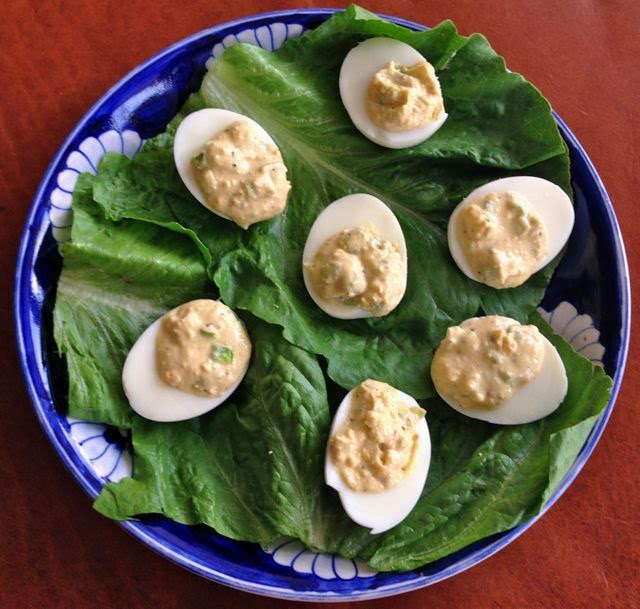
At the time, I begged to differ as I have been offered stuffed eggs in Iranian homes on a number of occasions. This little savoury treat, usually filled with a mixture of mustard, mayonnaise, pepper sauce, pepper and salt has long been a favourite in our home. I have been serving them up at dinner parties for many years in different countries.

Devilled Eggs with a Middle Eastern Flavour
But the question did haunt me. I had to ask myself where the devil did they come from?

After some scratching around in the historical henhouse, I discovered that devilled eggs go a very long way back. Baskets of boiled eggs can be seen in hieroglyphic drawings inside ancient Egyptian tombs. The Byzantine physician, Anthimus, wrote in his de observatione ciborum (On the Observance of Food) that boiled eggs are excellent for good health and recommended we eat lots of them.

It was, however, the ancient Romans – seemingly the first people to domesticate birds for their eggs – who concocted the idea of the stuffed egg.  Or at least, they were the first to record it in a recipe. Apicius, a Roman food writer from the late 4th century A.D. wrote the instructions for stuffed eggs in his book e re coquinaria (On the Subject of Cooking).

Apicius was the master chef of his day and On the Subject of Cooking appears to have been the go-to text in any Roman kitchen worth its salt. Contained in its pages is the trendy dish of boiled eggs, sliced in half and stuffed with a variety of ingredients and covered in a spicy sauce. They were served as appetisers to guests, reclining in togas on couches and drinking jars of wine.

Given that the Romans invited themselves into a large number of countries during their grand imperial tour, it would be safe to surmise that they also brought the stuffed egg with them to their new homes. Although stuffing the eggs with roasted flamingo probably no longer cuts the mustard in a modern kitchen, the devilled egg has remained on the menu ever since.

But where does the “devilled” aspect come from? Well, this is where the British influence does play a part. Apparently, in the 18th century, English cooks spiced up their meat, particularly offal, by cooking it with cayenne pepper and spices. The association of Hell being a reputedly hot place ignited the notion of spicy food being cooked by the Devil! The concept of adding some satanic spices to other food led us eventually to the devilled egg.

I recently read that devilled eggs were also a Middle Eastern delicacy, served to honoured guests in many locations along the ancient Silk Road. I leave you with an exquisite recipe from this part of the world.


Devilled Eggs with a Middle Eastern Flavour

8 eggs, hard-boiled for about 10 minutes and left to cool
2 to 3 tablespoons of chopped spring onions
4 tablespoons of plain yogurt
3 tablespoons of extra virgin olive oil
2 tablespoons of lemon juice (preferably fresh)
1 heaped teaspoon of Dijon mustard
Salt and freshly ground black pepper to taste

What to do:

Peel the eggs and cut them in half carefully. Scoop out the yolks into a bowl and set the egg whites aside.
Mash the egg yolks well and add all the other ingredients.
Stuff the egg whites with the mixture.
Chill in the fridge for at least an hour before serving.
Serve on a bed of lettuce.


Spinach option: if spinach is your thing, you can add about 250 grams of cooked and shredded spinach to the yolk mixture.

Thursday, 15 May 2014

Is there life without lavashak?

Apparently not!

Or so some of my dear Iranian friends tell me. The looks of astonishment when I asked what lavashak was, led me on a long journey of discovery to the Caspian Sea and back.

And so, what is this thing called lavashak? Well, it is quite simply a trip down memory lane.

Lavashak hanging up at roadside shop
Picture, in your mind’s eye, something looking like a giant fruit roll-up. That is lavashak. Iran produces some of the tastiest and organic fruit I have ever eaten.  Given that so much of Iran’s topography consists of arid desert or mountain ranges, it is difficult to imagine that the country produces so much wonderful fruit. But it does. And the fruit is delicious.


Apart from the largest and sweetest watermelons you are ever likely to see on the planet, Iran grows fabulous cherries (both sweet and sour), apricots, plums and pomegranates. These latter fruits are normally used to make lavashak.

An age-old process transforms these juicy fruits into a healthy and preservative-free snack.  Known locally as “fruit leather”, the key to the best sticky and lip-smacking lavashak is to use sour and tangy fruit.  Plums and sour cherries appear to be the most popular.

Lavashak is made by a time-honoured recipe of boiling then drying the fruit in the sun. And nothing could be easier in a country as sun-soaked as Iran. Such recipes have been handed down from generation to generation. It is a taste of days gone by but still enjoyed as much as ever. Best of all, it allows the fruit of the earth to be preserved and then eaten at any point in the year.

The method is not difficult.  Your fruit of choice is placed in a large pot and simmered until there is little or no juice left. Then the fruity mush is liquidized and poured into a large metal tray that has been oiled first. Deftly, you then spread the fruit mix out over the tray, cover with a piece of cheesecloth and set in the sun for several days until it is dried.  Modern cooks apparently cheat a little on this lengthy process, and cook the lavashak in the oven to help the drying process along.  And finally, when everything is ready, you need to skillfully roll it up, or fold it into little parcels and eat it.

Lavashak for sale!
And here, is where nostalgia plays its part. I was told that lavashak reminds people of holiday time and long drives to distant places.  Older people reminisce fondly about their youth, playing outdoors and eating strips of the stuff.  Exciting journeys to the seaside and to the mountains, even trips to the desert are not complete without a stop somewhere to pick up some lavashak.

Although modernity has brought with it commercial lavashak neatly packaged in brightly coloured bags, nothing can beat buying it from a roadside vendor.  Travel anywhere in Iran, and you can’t miss open trucks or little shops displaying lavashak in all its many flavours and deep rich colours.

You might want to come to Iran and taste it for yourself!


Lavashak
What you need:
Plums, apricots, cherries or sour cherries
The quantity depends on how much lavashak you want.  You could start with about 20 plums.
Oil to grease the tin tray
What to do:
Wash the fruit, take out the stones and put in a large pot.
Slowly boil until the water from the fruit has evaporated. Some recipes say to add a half-cup of water and one tablespoon of lemon juice at this stage, but the fruit should have enough water of its own. Be careful the fruit does not burn or stick to the bottom of the pan.
Use a strainer to remove skins, or put the whole lot in a food processor of liquidizer and zap it until you have a smooth puree.
Put some tin foil on top of a flat tin or cookie sheet. Grease the foil with some oil.  Pour the fruit puree onto the tray and using a spatula or the back of a spoon, spread the puree over the tray.
If you live in a place that is not too sunny, you can speed up the next part by baking the lavashak in the oven for 45 minutes to one hour at 250°F, 130°C, Gas Mark ½.
Cover the tray with some cheesecloth and leave in the sun to dry for two to four days.  Traditionally, in Iran the lavashak is left on the roof to dry.  Choose a good spot that is dust and pollution free.

After about four days, take off the cheesecloth and gently fold up the lavashak.